• Log In

The AAC Learning Center has moved to AAC-Learning-Center.org

  • Please click here to visit the new AAC Learning Center at AAC-Learning-Center.org

Designing AAC research and intervention to improve outcomes…(Light & McNaughton, 2015)

August 26, 2019 by David McNaughton

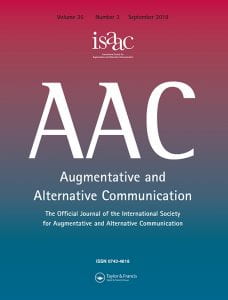
Cover of AAC JournalLight, J., & McNaughton, D. (2015). Designing AAC research and intervention to improve outcomes for individuals with complex communication needs. Augmentative and Alternative Communication, 31, 85-96.
http://www.tandfonline.com/doi/full/10.3109/07434618.2015.1036458

Abstract

There is a rapidly growing body of research that demonstrates the positive effects of augmentative and alternative communication (AAC) intervention on the communication of children and adults with complex communication needs. Despite the positive impact of many AAC interventions, however, many individuals with complex communication needs continue to experience serious challenges participating in educational, vocational, healthcare, and community environments. In this paper, we apply the framework proposed by the International Classification of Functioning, Disability and Health (ICF) to illustrate the need to re-think AAC intervention to improve outcomes for individuals with complex communication needs, and to foster a new generation of intervention research that will provide a solid foundation for improved services. Specifically, the paper emphasizes the need to take a more holistic view of communication intervention and highlights the following key principles to guide AAC intervention and research: (a) build on the individual’s strengths and focus on the integration of skills to maximize communication, (b) focus on the individual’s participation in real-world contexts, (c) address psychosocial factors as well as skills, and (d) attend to extrinsic environmental factors as well as intrinsic factors related to the individual who requires AAC.
Filed Under: Adults, Assessment, Children, Developmental disabilities, Education, Employment, Funding, Intervention, Language development, Publication, Research Tagged With: David McNaughton, free eprint, Janice Light, Light, McNaughton, publication

Access Technology for AAC and Adults

August 26, 2019 by David McNaughton

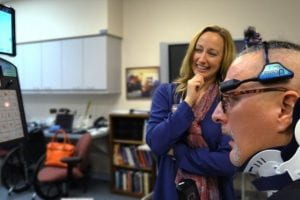
Adult with safe laserIn a recent podcast for Speech Uncensored, Dr. Susan Fager discussed her research on access and communication technology, and how the work she is completing translates to clinical practice. Susan also covered the progression from low tech to high tech AAC that a patient may experience across their recovery stages. Dr. Fager provided case studies to illustrate creative problem solving and overcoming obstacles to provide patients with a means to express themselves.

Filed Under: Access technology, Acquired disabilities, Adults, ALS, Assessment, Research to practice Tagged With: Fager, Susan Fager

Supporting Communication of Individuals with Minimal Movement

March 2, 2019 by David McNaughton

Susan Fager, Ph.D. CCC/SLP Institute for Rehabilitation Science and Engineering at Madonna Rehabilitation Hospital, Lincoln, Nebraska
David Beukelman,Ph.D. CCC/SLP University of Nebraska, Lincoln Institute for Rehabilitation Science and Engineering at Madonna Rehabilitation Hospital, Lincoln, Nebraska Munroe-Meyer Institute, University of Nebraska Medical Center
Webcast Description For many years we have provided AAC services to people with minimal movement capability. Their medical conditions include brainstem stroke, amyotrophic lateral sclerosis, Guillan Barre’ Syndrome, and chronic myasthenia gravis. As with others who rely on AAC, these people are multi-modal communicators in that they use high and low technology options depending upon the situation and the listener. High technology options include commercially available devices as well as technology under development. During the past year, we have provided presentations related to our work in this area at RESNA, the World Congress on Disability, and ATIA. In this webcast we present the content of those presentation through an interactive discussion format.
Additional Resources
  • Madonna Rehabilitation Hospital
  • AAC Center at the University of Nebraska-Lincoln
  • InvoTek, Inc.
Slides and handouts
  • Transcript of presentation (pdf)
  • Transcript of presentation (txt)
  • Powerpoint slides as a handout (pdf)
A 10-item quiz based on the content of this webcast, is available at the AAC Learning Center Moodle. You will need to register at the AAC Learning Center Moodle in order to complete the quiz. Upon successful completion of the quiz, you will be able to download a Certificate of Completion.
This webcast was produced as part of the work of the AAC-RERC under grant #H133E080011 from the National Institute on Disability and Rehabilitation Research (NIDRR)in the U.S. Department of Education’s Office of Special Education and Rehabilitative Services (OSERS)

Filed Under: Acquired disabilities, Adults, ALS, Assessment, Intervention, Research to practice Tagged With: ALS, David Beukelman, quiz, Susan Fager, webcast

The folly of fortune telling

October 14, 2018 by David McNaughton

Webcast description

Rob Rummel-Hudson describe the dangers of limited expectations, and the importance of opportunities and equity in achieving meaningful outcomes for his daughter, Schuyler.

First shown at the RERC on AAC State of the Science Conference in Arlington, Va, on July 13, 2018.
Text and photos by Rob Rummel-Hudson and Schuyler Hudson (video editing by David McNaughton)

Please cite as:

Rummel-Hudson, R. & Hudson, S. (2018, July 13). The folly of fortune telling. Retrieved from https://aac-learning-center.psu.edu/2018/10/14/the-folly-of-fortune-telling

Additional resources

Fighting Monsters with Rubber Swords

Filed Under: Adults, Assessment, Consumer perspectives, Developmental disabilities Tagged With: Rob Rummel-Hudson, webcast

Seating and positioning for people who use AAC

June 7, 2016 by David McNaughton


Dr. Aileen Costigan

Webcast Description
Appropriate seating and positioning is critical for use of assistive technology (AT) and participation in a variety of environments. Dr. Aileen Costigan, a certified Occupational Therapist, provides an introduction to important issues in seating and positioning for individuals who use AT.

This webcast was produced as part of the work of the AAC-RERC under grant #H133E080011 from the National Institute on Disability and Rehabilitation Research (NIDRR)in the U.S. Department of Education’s Office of Special Education and Rehabilitative Services (OSERS)

Filed Under: Assessment, Research to practice Tagged With: Aileen Costigan, Costigan, webcast

  • 1
  • 2
  • Next Page »

Copyright © 2026 · Enterprise Pro Theme on Genesis Framework · WordPress · Log in

The contents of this website are a joint offering of Penn State University and the RERC on AAC. They were developed, in part, under a grant from the National Institute on Disability, Independent Living, and Rehabilitation Research (NIDILRR grant number 90REGE0014) to the Rehabilitation Engineering Research Center on Augmentative and Alternative Communication (RERC on AAC). NIDILRR is a Center within the Administration for Community Living (ACL), Department of Health and Human Services (HHS). The contents of this website do not necessarily represent the policy of NIDILRR, ACL, or HHS, and you should not assume endorsement by the Federal Government.