• Log In

The AAC Learning Center has moved to AAC-Learning-Center.org

  • Please click here to visit the new AAC Learning Center at AAC-Learning-Center.org

Supporting Communication of Individuals with Minimal Movement

March 2, 2019 by David McNaughton

Susan Fager, Ph.D. CCC/SLP Institute for Rehabilitation Science and Engineering at Madonna Rehabilitation Hospital, Lincoln, Nebraska
David Beukelman,Ph.D. CCC/SLP University of Nebraska, Lincoln Institute for Rehabilitation Science and Engineering at Madonna Rehabilitation Hospital, Lincoln, Nebraska Munroe-Meyer Institute, University of Nebraska Medical Center
Webcast Description For many years we have provided AAC services to people with minimal movement capability. Their medical conditions include brainstem stroke, amyotrophic lateral sclerosis, Guillan Barre’ Syndrome, and chronic myasthenia gravis. As with others who rely on AAC, these people are multi-modal communicators in that they use high and low technology options depending upon the situation and the listener. High technology options include commercially available devices as well as technology under development. During the past year, we have provided presentations related to our work in this area at RESNA, the World Congress on Disability, and ATIA. In this webcast we present the content of those presentation through an interactive discussion format.
Additional Resources
  • Madonna Rehabilitation Hospital
  • AAC Center at the University of Nebraska-Lincoln
  • InvoTek, Inc.
Slides and handouts
  • Transcript of presentation (pdf)
  • Transcript of presentation (txt)
  • Powerpoint slides as a handout (pdf)
A 10-item quiz based on the content of this webcast, is available at the AAC Learning Center Moodle. You will need to register at the AAC Learning Center Moodle in order to complete the quiz. Upon successful completion of the quiz, you will be able to download a Certificate of Completion.
This webcast was produced as part of the work of the AAC-RERC under grant #H133E080011 from the National Institute on Disability and Rehabilitation Research (NIDRR)in the U.S. Department of Education’s Office of Special Education and Rehabilitative Services (OSERS)
Filed Under: Acquired disabilities, Adults, ALS, Assessment, Intervention, Research to practice Tagged With: ALS, David Beukelman, quiz, Susan Fager, webcast

Communication support for People with ALS

October 1, 2017 by David McNaughton

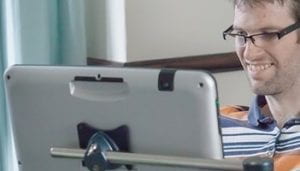
Steve with i-seriesBeukelman, D., Fager, S., & Nordness, A. (2011). Communication support for people with ALS. Neurology Research International, 2011.

http://dx.doi.org/10.1155/2011/714693

Almost all people with amyotrophic lateral sclerosis (ALS) experience a motor speech disorder, such as dysarthria, as the disease progresses. At some point, 80 to  of people with ALS are unable to meet their daily communication needs using natural speech. Unfortunately, once intelligibility begins to decrease, speech performance often deteriorates so rapidly that there is little time to implement an appropriate augmentative and alternative communication (AAC) intervention; therefore, appropriate timing of referral for AAC assessment and intervention continues to be a most important clinical decision-making issue. AAC acceptance and use have increased considerably during the past decade. Many people use AAC until within a few weeks of their deaths.

Link to free copy

Filed Under: Acquired disabilities, Adults, ALS Tagged With: Amy Nordness, David Beukelman, publication, Susan Fager

AAC for aphasia: Visual Scene Displays

October 1, 2017 by David McNaughton

  • David R. Beukelman, Ph.D.,
  • Karen Hux, Ph.D.,
  • Kristy Weissling, MA, CCC,
  • Aimee Dietz, MS, CCC,
  • Miechelle McKelvey, MA, CCC

Webcast Description
This presentation will review the research and development activities associated with the Visual Scenes Display (VSD) Project at the University of Nebraska, Lincoln .
Specifically:

  • The VSD interface will be demonstrated
  • The strategies for capturing and entering content for individuals with aphasia who rely on AAC will be discussed
  • Examples of VSD setups for specific individuals will be presented
  • Intervention outcomes will be reported.
  • Support Activities and Materials

 Additional Resources

Augmentative Communication News: Visual Scene Displays (August 2004)
This issue provides information on the use of Visual Scene Displays with beginning communicators and individuals with significant cognitive and/or linguistic limitations (pdf)

Visual Scene Displays (University of Nebraska)
University of Nebraska site for downloading Visual Scene Templates (link)

Filed Under: Acquired disabilities, Adults, Aphasia, Research to practice Tagged With: David Beukelman, featured, webcast

Copyright © 2026 · Enterprise Pro Theme on Genesis Framework · WordPress · Log in

The contents of this website are a joint offering of Penn State University and the RERC on AAC. They were developed, in part, under a grant from the National Institute on Disability, Independent Living, and Rehabilitation Research (NIDILRR grant number 90REGE0014) to the Rehabilitation Engineering Research Center on Augmentative and Alternative Communication (RERC on AAC). NIDILRR is a Center within the Administration for Community Living (ACL), Department of Health and Human Services (HHS). The contents of this website do not necessarily represent the policy of NIDILRR, ACL, or HHS, and you should not assume endorsement by the Federal Government.